

PRODUCT OVERVIEW
Infrastructure and installation
100% wireless system eliminates cables and exposed points. Robust construction with AR500 protection, 3 m/s speed, ±5 cm precision and 6–8 hour autonomy with automatic recharge.
360° rotation for tactical training
Full target rotation trains threat discrimination (standard face, back and edge), multiple target sequences and decision under pressure. Essential for police, military training and competitions.
Camera and visual feedback
Embedded FullHD camera streams target to tablet, view shots at distance without bringing retriever back. Instructors can correct technique immediately, shooters see documented progress, complete per-user history for analysis and gamification.
Intelligent RGBW lighting
Integrated LEDs encode tactical decision — green, red, blue. White LEDs for low light shooting, strobes for stress inoculation, rotation synchronization for dynamic scenarios. Complements ceiling lighting for realistic night training.
Routines and automation
Timeline-style visual editor creates complex sequences without programming: synchronize multiple retrievers, combine movements with rotations and lights, integrate external infrastructure (smoke, DMX strobes, exhaust). Create, save, and reuse custom routines for different training modalities.
Centralized management
Central tablet controls multiple lanes simultaneously. Offline-first system works without internet; optional remote access offers OTA updates, health telemetry, and predictive maintenance. Ideal for commercial ranges, security forces and elite operators.
PRODUCT OVERVIEW

Infrastructure and installation
100% wireless system eliminates cables and exposed points. Robust construction with AR500 protection, 3 m/s speed, ±5 cm precision, and 6–8 hour autonomy with automatic recharge.

360° rotation for tactical training
Full target rotation trains threat discrimination (front = shoot, back = hold), multiple target sequences, and decision under pressure. Essential for police, military training, and competitions.

Camera and visual feedback
Embedded 1080p camera streams target to tablet, view shots at distance without bringing retriever back. Instructors correct technique immediately, shooters see documented progress, complete per-user history for analysis and gamification.

Intelligent RGBW lighting
Integrated LEDs encode tactical decision — green = threat, red = civilian, blue = neutral. Automatic adaptation for low light, strobes for stress inoculation, rotation synchronization for dynamic scenarios. Complements ceiling lighting for realistic night training.

Routines and automation
Timeline-style visual editor creates complex sequences without programming: synchronize multiple retrievers, combine movements with rotations and lights, integrate external infrastructure (smoke, DMX strobes, exhaust). Create, save, and reuse custom routines for different training modalities.

Centralized management
Central tablet controls multiple lanes simultaneously. Offline-first system works without internet; optional remote access offers OTA updates, health telemetry, and predictive maintenance. Ideal for commercial ranges, security forces, and elite operators.
WIRELESS SYSTEM AND ENERGY
Proprietary 2.4 GHz wireless communication completely eliminates power and control cables. The onboard lithium battery delivers 6 to 8 hours of continuous operation, sized for full training shifts without interruptions. The retriever moves on standard market rail (2-inch T-profile), reaching maximum speed of 3 m/s with digitally configurable acceleration and braking via servo motor, enabling everything from instant positioning to moving targets for dynamic shooting.
The system eliminates complex cable infrastructure, conduits, and contact brushes: simplified installation (40 to 60% faster than traditional systems), zero maintenance for oxidation or shrapnel breakage, and predictable 24/7 operation. When charge reaches low level or after configurable idle period, the retriever automatically returns to the charging base (autodock), charging from 0 to 80% in 90 minutes without manual intervention. Multiple retrievers operate in synchronized fashion, maintaining positioning precision across all shooting lanes.
Available in three rail options: local purchase of 2-inch structural T-profile with self-installation, pre-fabricated aluminum modules with adjustable fittings that ensure alignment and full contact of supports and drive wheel (facilitated replacement of damaged modules in the field), or complete turnkey supply with modular rails (installation + ready-to-use equipment.
Proprietary 2.4 GHz wireless communication completely eliminates power and control cables. The onboard lithium battery delivers 6 to 8 hours of continuous operation, sized for full training shifts without interruptions. The retriever moves on standard market rail (2-inch T-profile), reaching maximum speed of 3 m/s with digitally configurable acceleration and braking via servo motor, enabling everything from instant positioning to moving targets for dynamic shooting.
The system eliminates complex cable infrastructure, conduits, and contact brushes: simplified installation (40 to 60% faster than traditional systems), zero maintenance for oxidation or shrapnel breakage, and predictable 24/7 operation. When charge reaches low level or after configurable idle period, the retriever automatically returns to the charging base (autodock), charging from 0 to 80% in 90 minutes without manual intervention. Multiple retrievers operate in synchronized fashion, maintaining positioning precision across all shooting lanes.
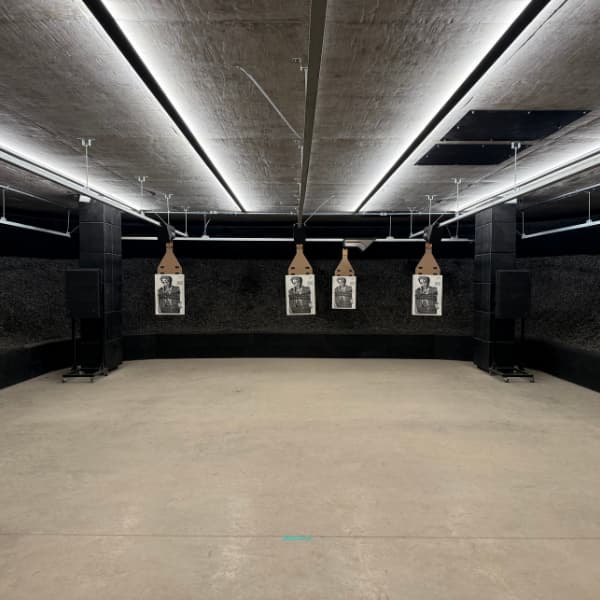
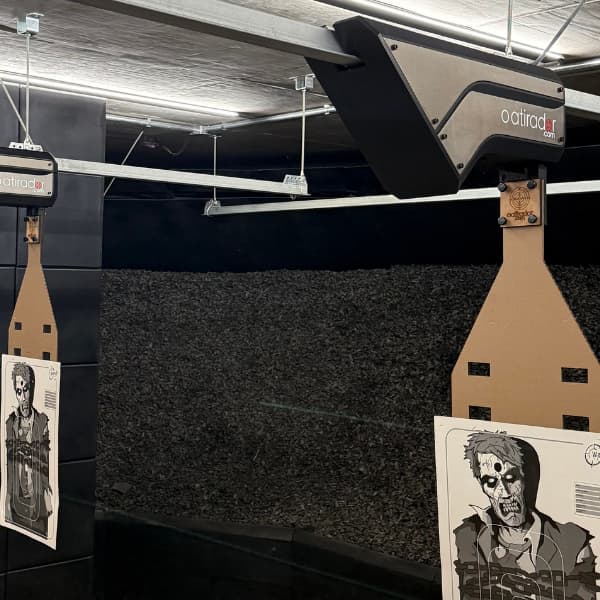
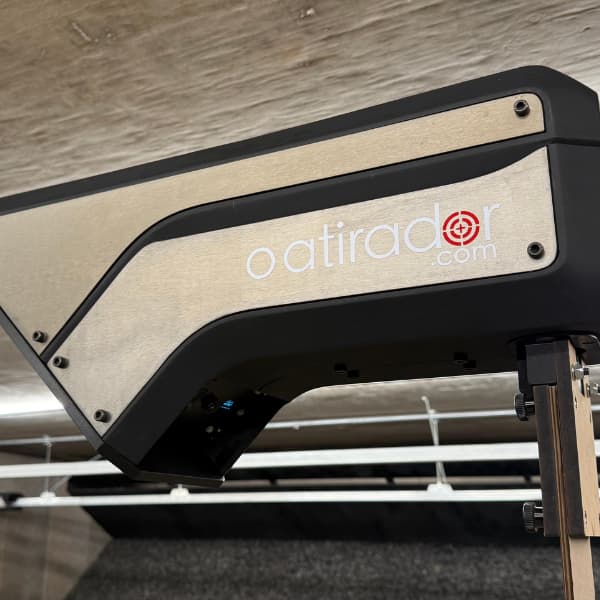
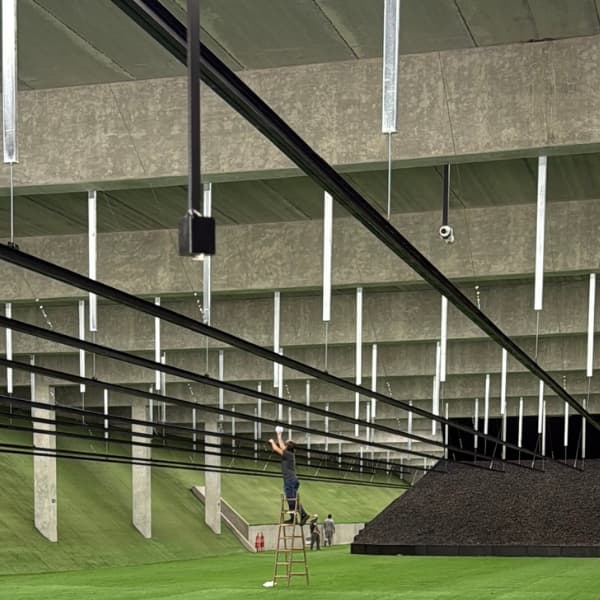
Available in three rail options: local purchase of 2-inch structural T-profile with self-installation, pre-fabricated aluminum modules with adjustable fittings that ensure alignment and full contact of supports and drive wheel (facilitated replacement of damaged modules in the field), or complete turnkey supply with modular rails (installation + ready-to-use equipment).
CAMERA AND RECOGNITION
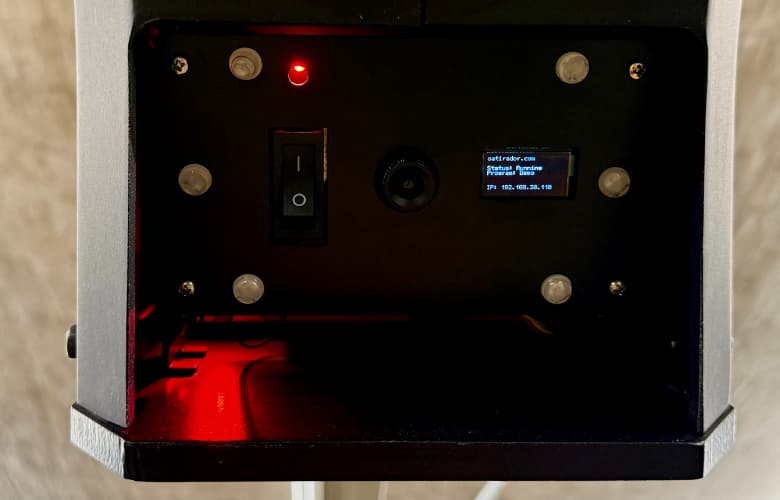
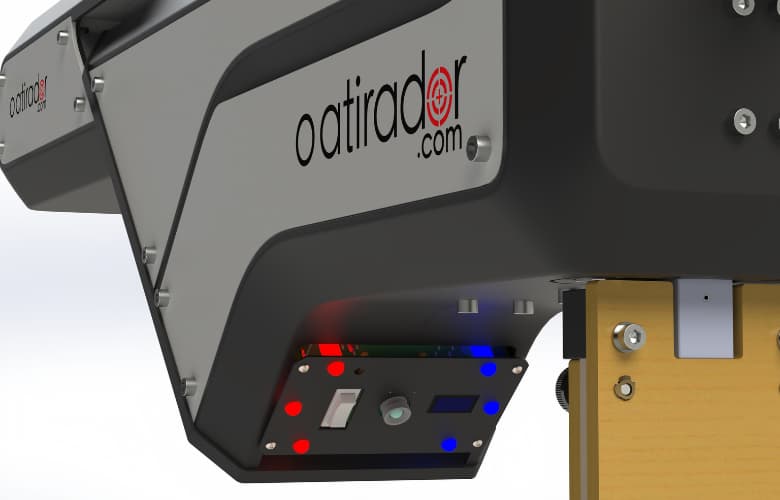
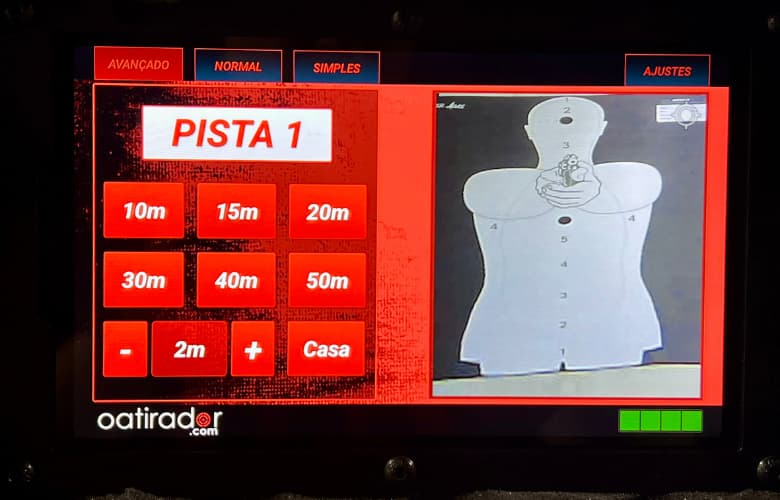
HD camera with high light sensitivity, built to operate in low-light ranges while keeping the target sharp. Sits protected on the underside of the retriever, in a dedicated compartment that shields it from impacts and fragments. The software automatically corrects framing so the target appears head-on even when the camera is looking from above.
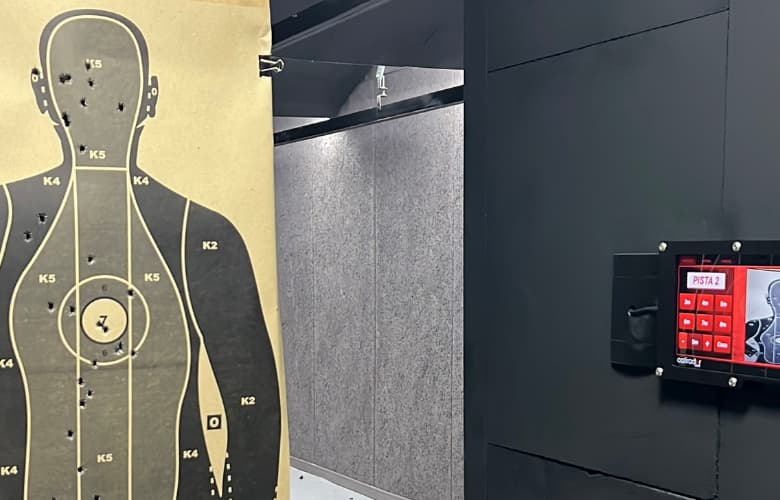
The main advantage is seeing the target at long distances without moving the retriever back: instructor and shooter watch impacts on the tablet, keeping training or competition flowing. Multiple targets can be combined into a single mosaic view, projected in a control room or for spectators, helping with auditing, broadcast, and demos.
The system streams video with low typical latency, adds auxiliary lighting to improve contrast, and offers local and cloud storage with encryption. Automatic shot recognition, results tallying, metrics (CEP, vertical/horizontal dispersion, hit factor), and per-shooter reporting are in active development, with export and retention options available.
HD camera with high light sensitivity, built to operate in low-light ranges while keeping the target sharp. Sits protected on the underside of the retriever, in a dedicated compartment that shields it from impacts and fragments. The software automatically corrects framing so the target appears head-on even when the camera is looking from above.
The main advantage is seeing the target at long distances without moving the retriever back: instructor and shooter watch impacts on the tablet, keeping training or competition flowing. Multiple targets can be combined into a single mosaic view, projected in a control room or for spectators, helping with auditing, broadcast, and demos.
The system streams video with low typical latency, adds auxiliary lighting to improve contrast, and offers local and cloud storage with encryption. Automatic shot recognition, results tallying, metrics (CEP, vertical/horizontal dispersion, hit factor), and per-shooter reporting are in active development, with export and retention options available.
ROTATING TARGET (360° ROTATION)
TANK includes continuous 360° rotation with programmable angles (front/edge/back and intermediate positions), enabling short exposure windows that can be predictable or fully randomized. This turns training into a dynamic stimulus: the shooter must recognize what is being shown and decide under time pressure, instead of simply executing shots on a static target. Exposure time and “edge time” can be tuned for progressive learning—from slower settings for beginners to fast windows for advanced operators.
Rotation integrates directly with routines and RGBW lighting for shoot/no-shoot decision training: the target can rotate while lights define the scenario rule in real time (green authorizes, red forbids), forcing context reading plus target position awareness. It also enables precision-in-a-window drills (partial exposure, hostage rescue targets, quadrant exposure), with repeatable sequences and consistent metrics for debriefing and objective improvement.

TANK includes continuous 360° rotation with programmable angles (front/edge/back and intermediate positions), enabling short exposure windows that can be predictable or fully randomized. This turns training into a dynamic stimulus: the shooter must recognize what is being shown and decide under time pressure, instead of simply executing shots on a static target. Exposure time and "edge time" can be tuned for progressive learning—from slower settings for beginners to fast windows for advanced operators.
Rotation integrates directly with routines and RGBW lighting for shoot/no-shoot decision training: the target can rotate while lights define the scenario rule in real time (green authorizes, red forbids), forcing context reading plus target position awareness. It also enables precision-in-a-window drills (partial exposure, hostage rescue targets, quadrant exposure), with repeatable sequences and consistent metrics for debriefing and objective improvement.
RGBW LIGHTING

Integrated RGBW LED system with full operator control over brightness, intensity, and operating modes. Supportsa multiple modes: static color, pulsation, strobe, and smooth intensity transitions. Efficient consumption with extended lifespan. Tactical function operates through color encoding that integrates rapid decision-making into training: green signals threat (shooter fires), red signals civilian or hostage (shooter holds), blue indicates neutral target. In a typical 360° rotation scenario, the target rotates while lights change simultaneously — "target front in green = threat, authorized"; "target turns back in red = civilian, cease-fire" — forcing instant position + color reading, accelerating decision reflex. For realistic training, strobe synchronized with fast target rotation forces decision under extreme visual pressure. White light complements as additional assistance when needed — in environments with insufficient lighting, it provides clear sight picture and target visibility for precision training without compromising tactical objective.
Integrated RGBW LED system with full operator control over brightness, intensity, and operating modes. Supportsa multiple modes: static color, pulsation, strobe, and smooth intensity transitions. Efficient consumption with extended lifespan.
Tactical function operates through color encoding that integrates rapid decision-making into training: green signals threat (shooter fires), red signals civilian or hostage (shooter holds), blue indicates neutral target. In a typical 360° rotation scenario, the target rotates while lights change simultaneously — “target front in green = threat, authorized”; “target turns back in red = civilian, cease-fire” — forcing instant position + color reading, accelerating decision reflex. For realistic training, strobe synchronized with fast target rotation forces decision under extreme visual pressure. White light complements as additional assistance when needed — in environments with insufficient lighting, it provides clear sight picture and target visibility for precision training without compromising tactical objective.
Offers complete flexibility for multiple scenarios: tactical training with color-based decisions, precision shooting with complementary white light, controlled-environment operations, and night training in commercial ranges. With multi-lane synchronization, a single command activates all lights coordinated, creating instant scenarios. Custom routines sequence colors and effects dynamically, mapping exactly the desired tactical scenario.

CONSTRUCTION, PROTECTION, AND MOUNTING
Striking design combines robustness and innovation, with multi-level ballistic protection integrated into the structure. The 3/8″ (9.5mm) AR500 front plate forms an angled barrier that deflects virtually any common caliber, especially protecting the battery positioned right behind it. The structural assembly receives laser welds at all critical points, followed by high-adhesion electrostatic paint applied to the welded assembly, ensuring superior quality and finish. The reinforced plastic casing reduces weight without compromising strength, covering non-critical components and facilitating access to the equipment interior. The 3mm AR500 side plates are brushed and varnished, creating visual contrast that highlights ballistic protection and provides a modern, professional look.
Ensures operational continuity, without stop from accidental shot. The design favors minimal maintenance and total modularity, with simple interior access for visual inspection and field component replacement — mean time to repair under 30 minutes without special tools. Internal components follow industrial standards for easy replacement, while the two internally developed electronic boards (software and hardware) are protected by encryption and modular for quick substitution when needed. Polyurethane wheels, battery, camera and motor are easily replaceable, maintaining the system operational with minimal technical intervention.
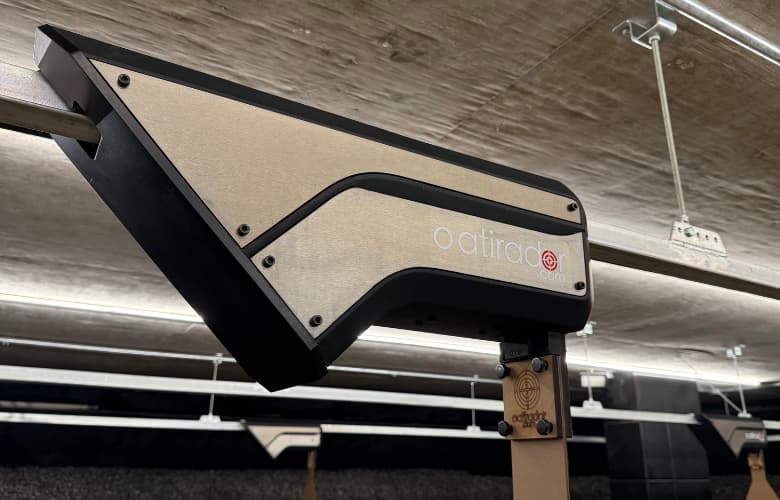
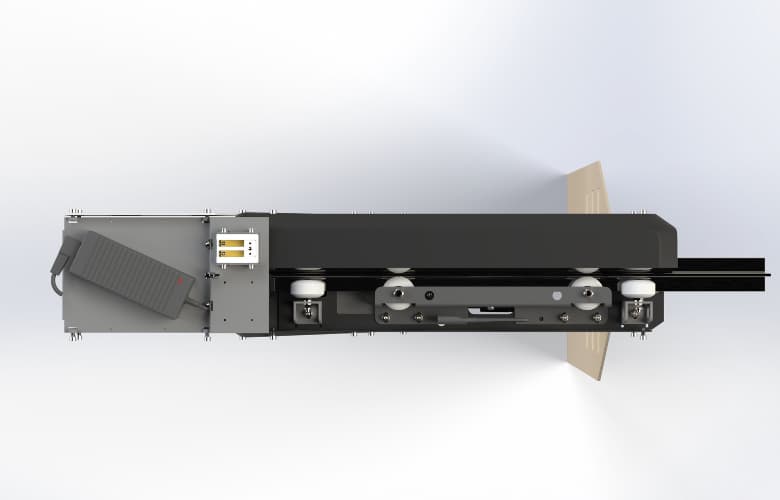
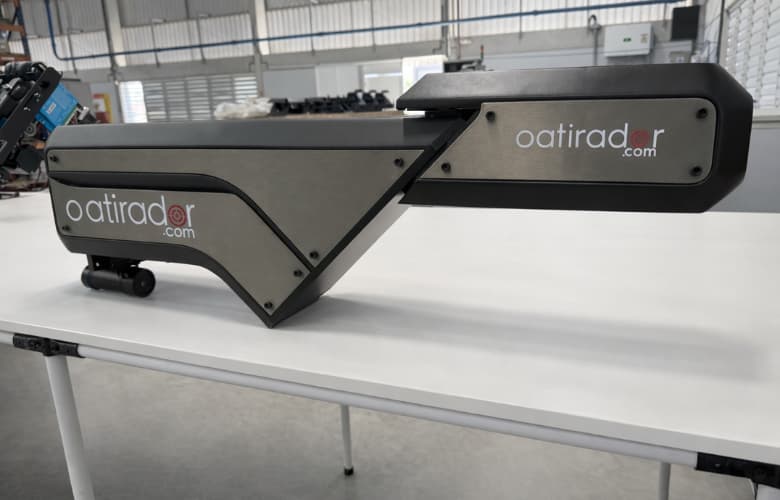
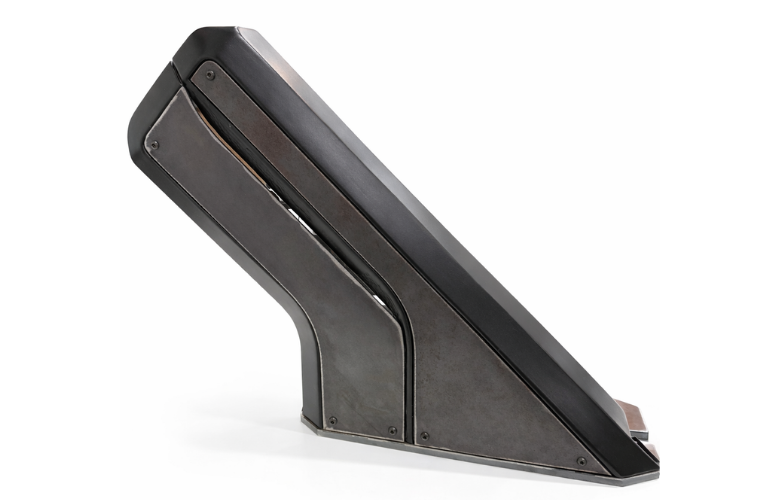
Striking design combines robustness and innovation, with multi-level ballistic protection integrated into the structure. The 3/8" (9.5mm) AR500 front plate forms an angled barrier that deflects virtually any common caliber, especially protecting the battery positioned right behind it. The structural assembly receives laser welds at all critical points, followed by high-adhesion electrostatic paint applied to the welded assembly, ensuring superior quality and finish. The reinforced plastic casing reduces weight without compromising strength, covering non-critical components and facilitating access to the equipment interior. The 3mm AR500 side plates are brushed and varnished, creating visual contrast that highlights ballistic protection and provides a modern, professional look.
Ensures operational continuity, without stop from accidental shot. The design favors minimal maintenance and total modularity, with simple interior access for visual inspection and field component replacement — mean time to repair under 30 minutes without special tools. Internal components follow industrial standards for easy replacement, while the two internally developed electronic boards (software and hardware) are protected by encryption and modular for quick substitution when needed. Polyurethane wheels, battery, camera and motor are easily replaceable, maintaining the system operational with minimal technical intervention.
Decisão imediata por cores, agilizando a identificação de ameaça, civil ou alvo neutro
Iluminação RGBW integrada, com luz branca auxiliar para precisão em baixa luminosidade
Sincronização com rotação 360°, elevando o nível de estresse visual e reflexo decisório
- Immediate color-coded decision-making, speeding up the identification of threats, civilians, or neutral targets.
- Synchronization with 360° rotation, increasing the level of visual stress and decision-making reflexes.
- Integrated RGBW lighting, with auxiliary white light for precision in low light conditions.
MANAGEMENT AND AUTOMATION
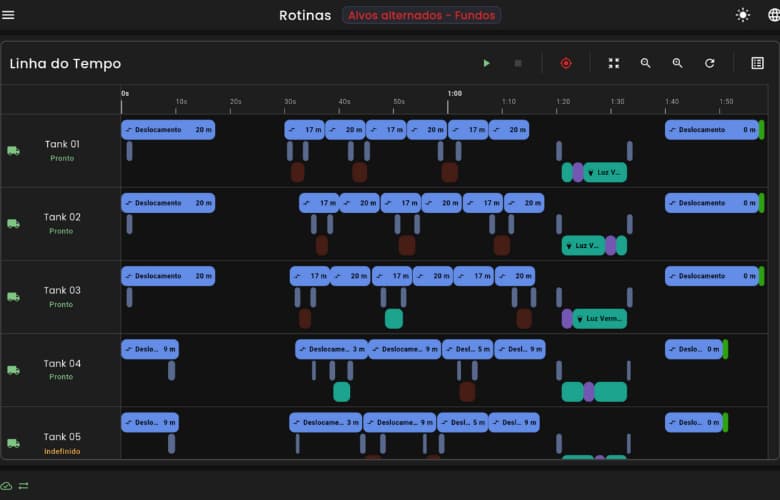
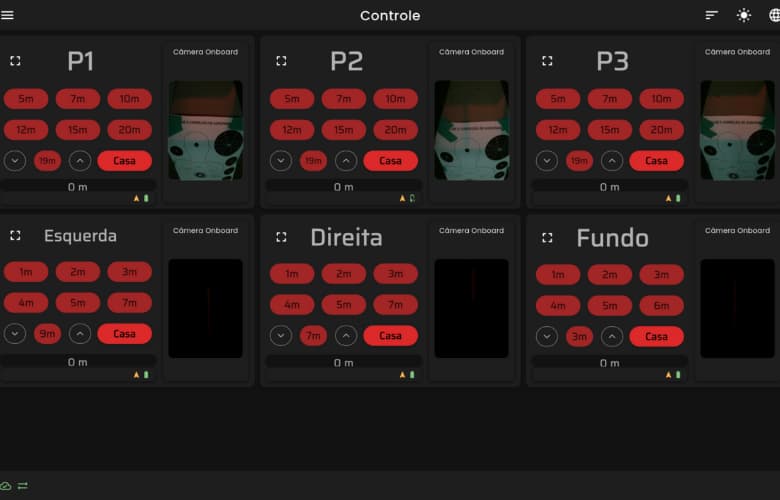
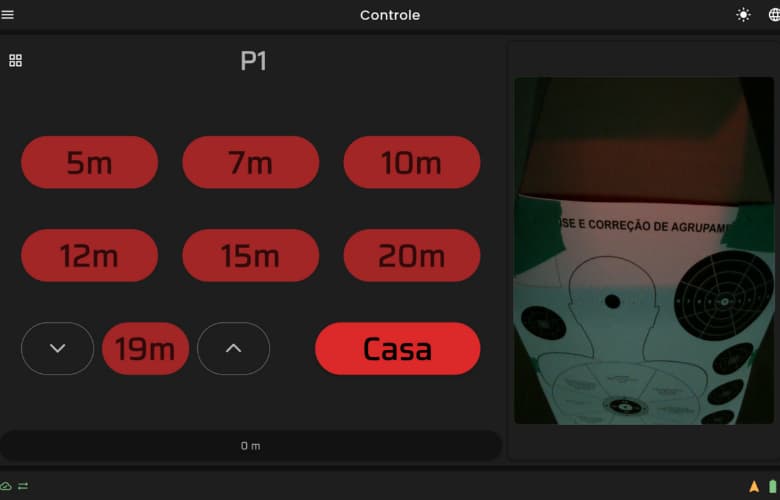
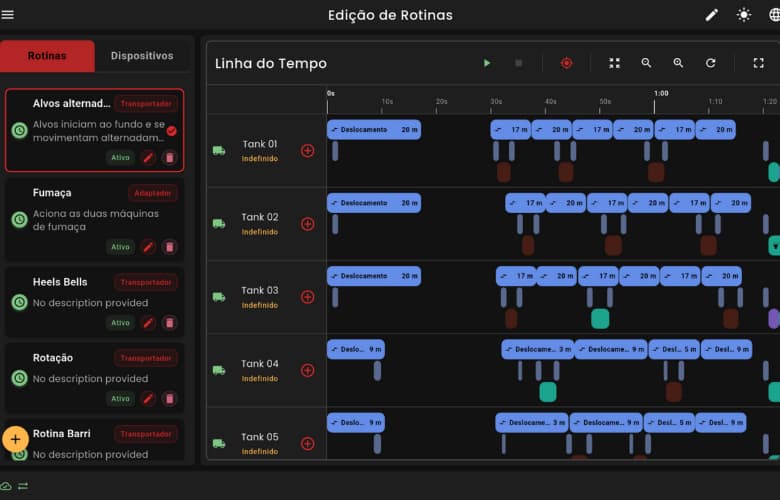
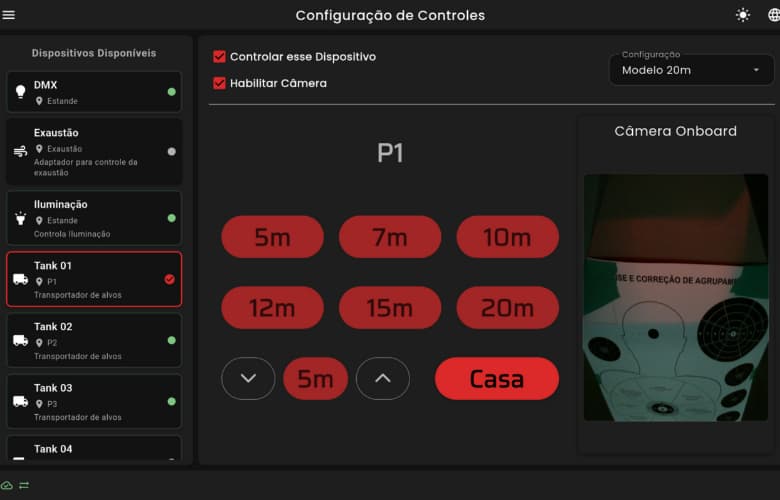
Each retriever has its individual tablet with meter-by-meter distance control or pre-programmed distances, embedded camera viewing with digital zoom, and simple drill editor for that specific line — sequences of distances, target rotations, and RGBW lighting changes. The central tablet expands control to multiple retrievers simultaneously, offering unified screen with distance controls and cameras from all lines, grid view of all cameras, device settings per registered user, and creation of complex routines that synchronize multiple retrievers. Central computer can replace tablet for greater comfort when creating elaborate routines, with large screen and full keyboard facilitating fine adjustments.
Enables from basic individual operation to complex and synchronized tactical scenarios. Provided adapters integrate external devices via DMX protocol: ambient lighting, exhaust, light cannons, strobes, smoke machines, and any other compatible equipment — making it possible to create extremely realistic training environments, from stress scenarios with strobes and smoke to precision training with controlled lighting. Instructor defines specific conditions: "line 1 advances while line 3 retreats, light cannons flash, smoke activates gradually, exhaust turns on at 80%", all coordinated visually on timeline.
The routine editor operates intuitively: first add desired devices (retrievers, lights, smoke, etc.), then insert action blocks on a horizontal timeline. Synchronizing is visual: aligned blocks execute simultaneously, sequential blocks create temporal progression. Each action allows fine tuning — intensity of each RGBW light, speed of each movement, duration of each pause, angle of each rotation — all visually configurable without programming need. Short and intense routines for quick drills or long and complete routines for elaborate tactical training, everything is practical to create, test, save, and reuse.
Each retriever has its individual tablet with meter-by-meter distance control or pre-programmed distances, embedded camera viewing with digital zoom, and simple drill editor for that specific line — sequences of distances, target rotations, and RGBW lighting changes. The central tablet expands control to multiple retrievers simultaneously, offering unified screen with distance controls and cameras from all lines, grid view of all cameras, device settings per registered user, and creation of complex routines that synchronize multiple retrievers. Central computer can replace tablet for greater comfort when creating elaborate routines, with large screen and full keyboard facilitating fine adjustments.
Enables from basic individual operation to complex and synchronized tactical scenarios. Provided adapters integrate external devices via DMX protocol: ambient lighting, exhaust, light cannons, strobes, smoke machines, and any other compatible equipment — making it possible to create extremely realistic training environments, from stress scenarios with strobes and smoke to precision training with controlled lighting. Instructor defines specific conditions: “line 1 advances while line 3 retreats, light cannons flash, smoke activates gradually, exhaust turns on at 80%”, all coordinated visually on timeline.
The routine editor operates intuitively: first add desired devices (retrievers, lights, smoke, etc.), then insert action blocks on a horizontal timeline. Synchronizing is visual: aligned blocks execute simultaneously, sequential blocks create temporal progression. Each action allows fine tuning — intensity of each RGBW light, speed of each movement, duration of each pause, angle of each rotation — all visually configurable without programming need. Short and intense routines for quick drills or long and complete routines for elaborate tactical training, everything is practical to create, test, save, and reuse.
CLOUD, OTA E TELEMETRIA
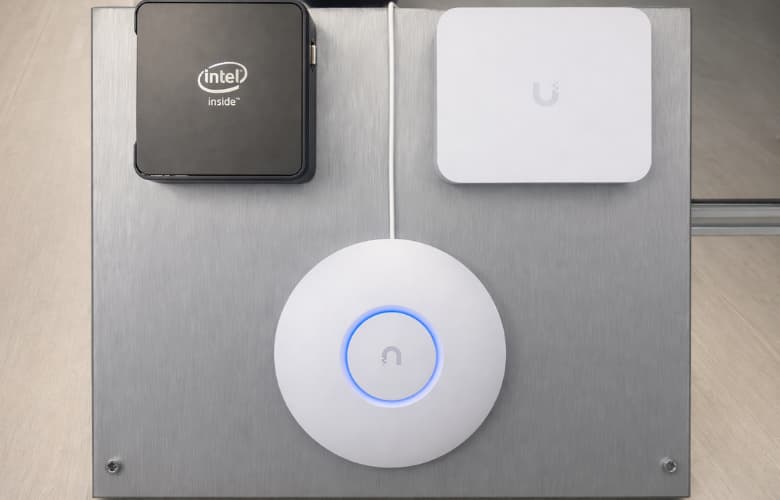
The network operates on Ubiquiti gear (Unifi line): UCG Ultra gateway for secure routing, U6 Plus APs for stable Wi‑Fi, and a closed network (no external devices) to avoid conflicts. A UPS keeps everything alive during power loss, a local server centralizes commands, routines, and users, and network updates/telemetry/retriever control go through it with low latency. All Unifi management stays visible: who's connected, signal strength, transmission quality, and traffic prioritization—without opening the network to third parties.
The retriever streams full telemetry: battery level, charging intensity, per-servo power draw, vibration, inclination, and temperatures at 4 critical points. Data stays on the server and can be accessed remotely for support and predictive maintenance.
With historical data and AI, we identify client-specific patterns to optimize performance: suggest maintenance windows, fine-tune speeds and movements on specific lanes, detect battery degradation or weak-signal zones. The closed network eliminates visitor interference, the UPS ensures continuity, and the server keeps everything under control with data ready for analysis and continuous improvement.
The network operates on Ubiquiti gear (Unifi line): UCG Ultra gateway for secure routing, U6 Plus APs for stable Wi‑Fi, and a closed network (no external devices) to avoid conflicts. A UPS keeps everything alive during power loss, a local server centralizes commands, routines, and users, and network updates/telemetry/retriever control go through it with low latency. All Unifi management stays visible: who’s connected, signal strength, transmission quality, and traffic prioritization—without opening the network to third parties.
The retriever streams full telemetry: battery level, charging intensity, per-servo power draw, vibration, inclination, and temperatures at 4 critical points. Data stays on the server and can be accessed remotely for support and predictive maintenance.
With historical data and AI, we identify client-specific patterns to optimize performance: suggest maintenance windows, fine-tune speeds and movements on specific lanes, detect battery degradation or weak-signal zones. The closed network eliminates visitor interference, the UPS ensures continuity, and the server keeps everything under control with data ready for analysis and continuous improvement.